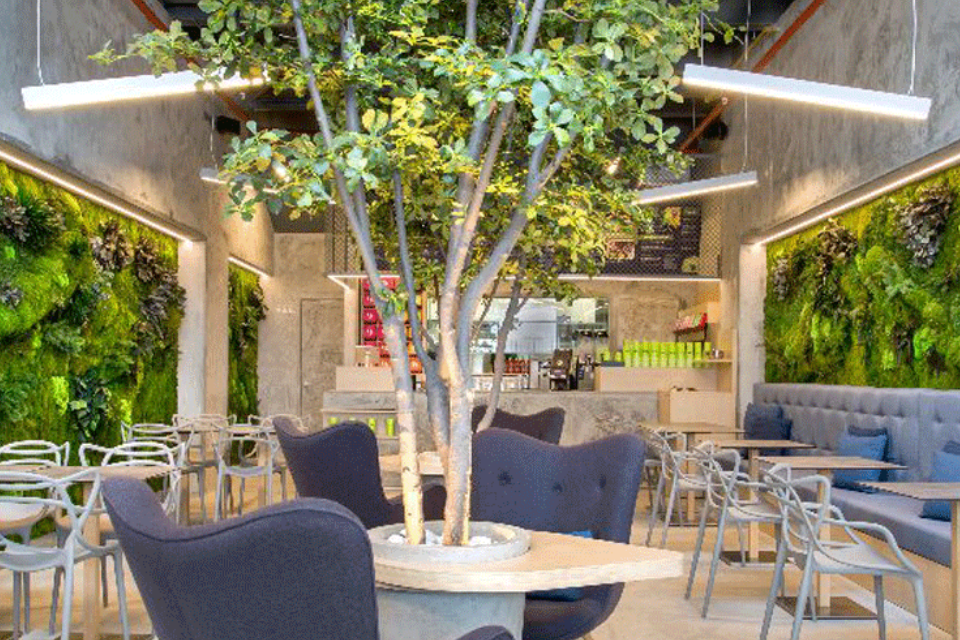
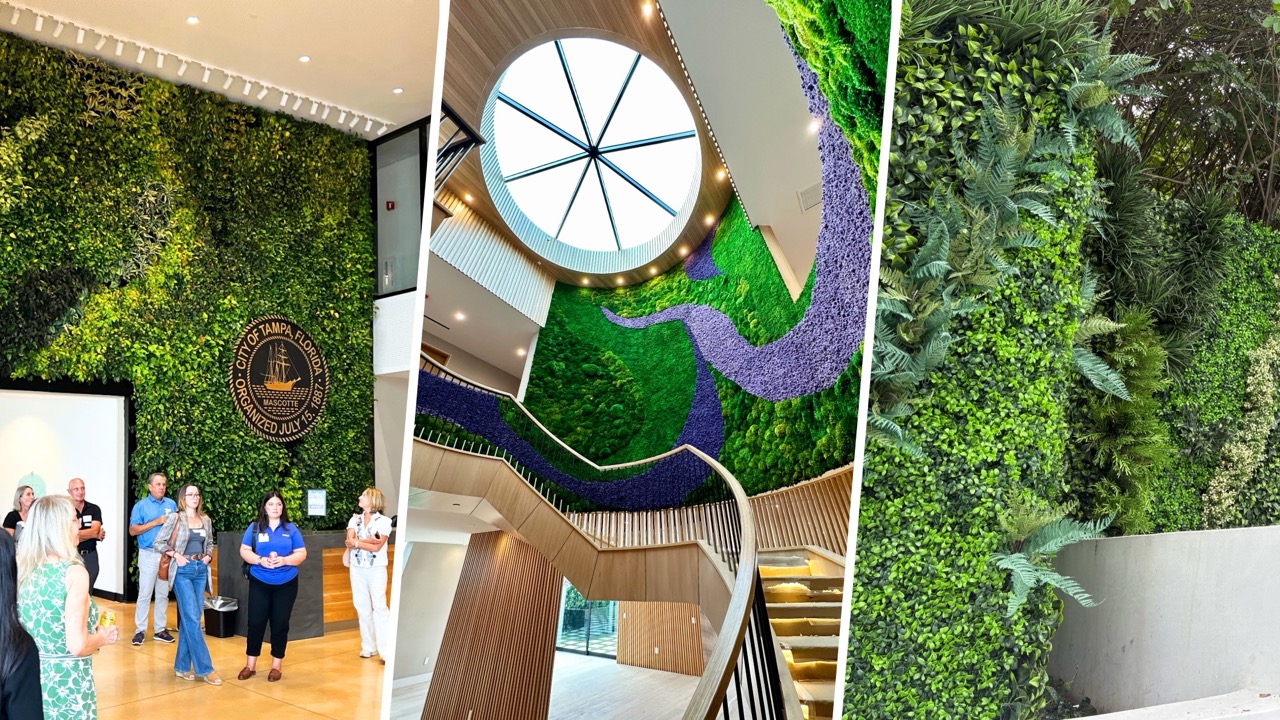
Stand in front of a living wall and your eye reads dozens of greens at once: the deep, glossy green of one leaf, the silvery green of the next, the yellow-green of new growth catching the light. Your response to it isn't only a matter of taste. In daylight, the human eye is more sensitive to green than to any other color. A greenwall speaks to the part of the spectrum we're wired to notice most, and the best biophilic design uses that on purpose.
Here's the science behind it, and how to design with it.
Why the eye is built for green
In daylight, the human eye is most sensitive to light at a wavelength of about 555 nanometers, which sits squarely in the green part of the spectrum. The international standard that describes how bright we perceive each wavelength of light to be, the CIE photopic luminosity function, peaks right there (RP Photonics). Of all the light in front of you, green is what your eye responds to most strongly.
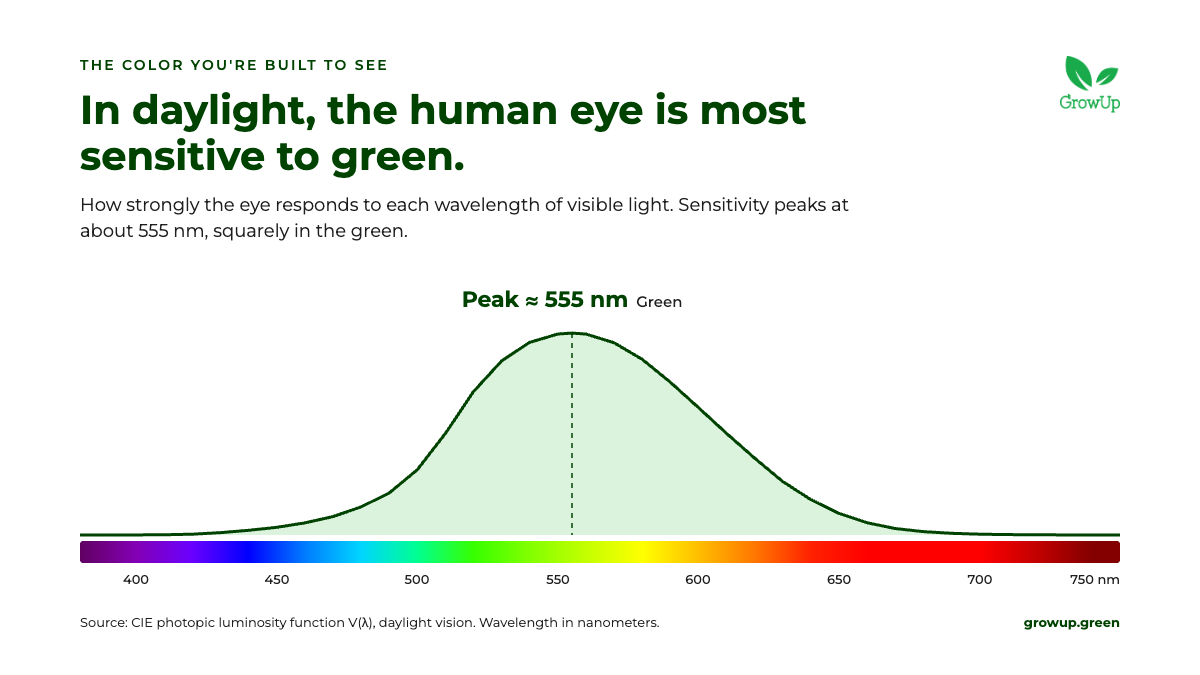
You may have heard a popular claim: that we can see more shades of green than any other color. It's harder to pin down. The measurable fact is the one above: daylight vision is most sensitive in the green band.
Our color vision is also tied to the living world. One long-standing hypothesis links primate color vision to foraging: picking out ripe fruit and young, reddish leaves against a background of green foliage. As evolutionary biologist Adriana Briscoe of the University of California, Irvine puts it, red-green color vision "allows primates to forage for red conspicuous fruits against a green foliage" (NHPR). Reading the living world closely was a survival skill.
From seeing green to living nature
Green catches the eye. Living nature is what the research shows does measurable good, and that's where biophilic design earns its place in a project brief.
- Nature in view supports recovery. In a landmark 1984 study, surgical patients with a view of nature had shorter hospital stays than matched patients facing a brick wall (Ulrich, Science).
- Biophilic spaces lower physiological stress. In a Harvard T.H. Chan School of Public Health study of virtual-reality offices, participants' systolic blood pressure was 8.6 mmHg lower in the biophilic environment than in the non-biophilic one (Yin et al., Indoor Air, 2019).
- Plants lift performance. In field experiments in real commercial offices, adding plants to a lean office increased productivity by 15% (Nieuwenhuis et al., 2014).
The eye is drawn to green, and real nature in a space does measurable good. Together, that's the case for treating greenery as a deliberate design material, not an afterthought.
Fifty shades, and then some: designing with a living palette
Green is where the eye is most alive. But a great greenwall isn't limited to green. GrowUp's living, moss and faux walls give designers a full palette: fifty shades of green when you want depth, and color beyond green when the design calls for it.
Living walls: the deepest range of green
This is where "fifty shades of green" is literally true. A Custom Living Wall is built plant by plant from real, full-size plants, so the palette is shaped by plant selection: color, texture, leaf size and form, matched to the light, water and climate of the space. And because it's alive, it keeps developing: new leaves unfurl, plants mature and the composition deepens over time.
Moss walls: rich, sculptural texture
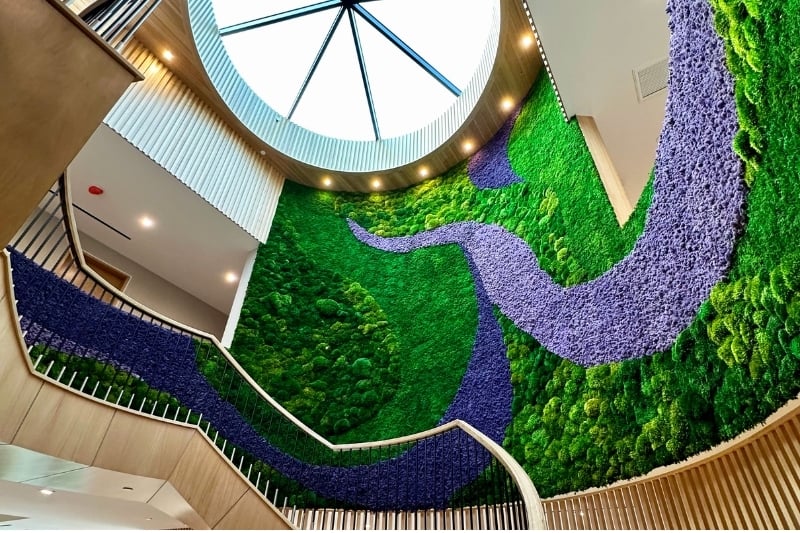
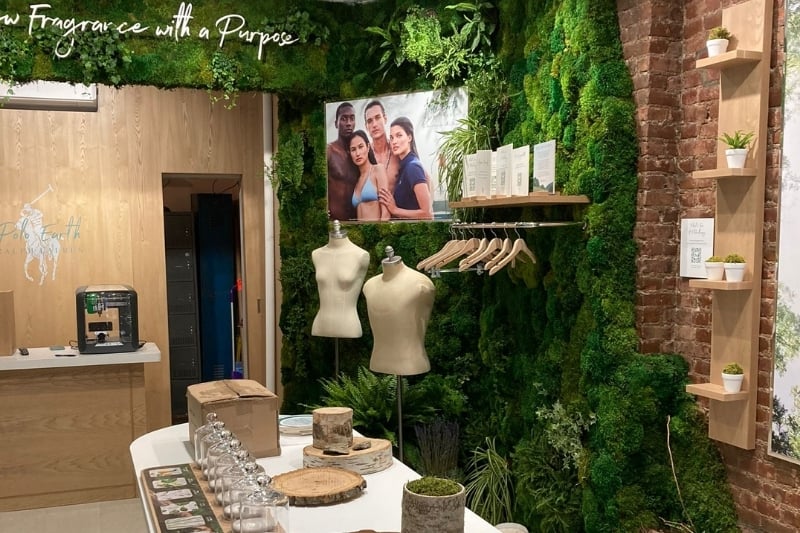
A Custom Preserved Moss Wall brings the natural texture, color and softness of real moss into an interior, with no irrigation, soil, supplemental lighting or horticultural maintenance. Different moss varieties, a wide color range and custom dyeing give it broad creative control: deep, layered greens, project-specific palettes, patterns, artwork and brand applications. Color availability is confirmed for each project.
Faux walls: control where living material can't go
Where light, water or ongoing plant care rule out living material, our faux greenwalls bring the look of nature with no water, light or pruning. Custom compositions and patterns give designers control over texture and tone, and options are available for outdoor projects.
The through-line
Each solution earns its place on its own merits. Living walls bring growth and change, moss brings texture, and faux brings resilience in tough conditions. The design decision is about fit: maximum living green where the space can support it, and the right material wherever it can't. Not sure which fits your project? Our guide to moss vs living vs faux walls walks through the trade-offs.
How to design with green on purpose
A few principles we bring to every greenwall:
- Layer tones for depth. A flat field of a single green reads as a surface. Layering light and dark greens with contrasting textures gives the eye the variety it's built to enjoy, and the wall reads richer from every distance.
- Let light do the work. Green changes under different light, and a living wall shifts through the day. Plan the lighting with the wall, not after it. Indoor living walls often need supplemental grow lights, and we help specify them.
- Use color beyond green with intent. Accents of other colors work best when they have a job: echoing a brand, marking a route through a space, or creating a focal point.
- Match the system to the constraints. Light, water, structure, climate and maintenance decide which solution belongs in a space. Choose for the conditions you actually have.
Design for the eye you actually have
We're built to see green. Great biophilic design uses that on purpose, then reaches for the rest of the palette with intent. Whether the project calls for fifty shades of living green, sculptural moss or a faux composition that holds up in tough conditions, GrowUp takes it from concept and specification through to installation.

Ready to spec the right wall for your space?
Download the Green Wall Solution Type Comparison, a one page reference you can drop straight into a spec set.
Working through a specific project? Book a design consultation and we will help you weigh the options for your space, light, and budget.
Greenwall Solution Type Comparison Book a Design Consultation
Frequently asked questions
Is the human eye really most sensitive to green?
Yes. In daylight, the eye's sensitivity peaks at a wavelength of about 555 nanometers, in the green part of the spectrum. The popular claim that we see "more shades of green than any other color" is a separate idea and harder to pin down.
Is there evidence that nature in a space improves wellbeing?
Yes. Research on biophilic design has linked views of nature to shorter hospital stays, biophilic office environments to lower blood pressure, and plants in offices to higher productivity. A living wall brings real nature inside.
Can a green wall include colors other than green?
Yes. Living wall palettes are shaped by plant selection for color and texture. Preserved moss comes in a wide color range and can be custom dyed. Faux walls can be composed in custom patterns.
Which kind of greenwall gives designers the most control over color?
Preserved moss offers the most direct control, through its color range and custom dyeing, and faux walls add control through custom compositions. A living wall's palette comes from plant selection and keeps evolving as the plants grow.
How do you plan a living wall plant palette?
Plants are chosen during a design consultation for color, texture, water use, light and climate. Plants that share a wall must have closely matched requirements, because they share the same irrigation and conditions.
Updated: October 28, 2026