A specifier's guide to the three green wall solution types, and the trade-offs that decide which one belongs on your drawing.
A biophilic feature has made it onto the concept board. The client loves it. Now it has to survive spec, procurement, and install, then arrive on opening day looking exactly the way it was sold.
That journey is where most green walls succeed or fail, and it starts with one decision: which type of wall are you actually specifying? Living, moss, and faux are three genuinely different solutions with different costs, care requirements, lifespans, creative ranges, and environmental limits. Choose the right one for the space and the wall becomes the moment everyone remembers. Choose the wrong one and it gets value engineered out at pricing, or it gets installed and quietly disappoints.
There is no single best green wall. There is only the right one for this light, this budget, this maintenance reality, and this design intent. What follows walks the trade-offs the way you would weigh them on a real project, so you can spec with confidence and defend the line item all the way to the owner.
The three solution types at a glance
| Living Wall | Preserved Moss Wall | Faux Wall | |
| What it is | Real, growing plants in a modular system | Real moss, preserved and no longer living | Engineered artificial foliage |
| Indoor / Outdoor | Both | Indoor only | Both (UV rated) |
| Maintenance | Scheduled care (water, light, pruning) | None | None, beyond occasional dusting |
| Expected Lifetime | Indefinite with ongoing care | 8 to 10 years before fading begins, often much longer | 10+ years in suitable conditions |
| Customization | Plant palette, plus shape and scale | Color, shape, texture, imagery, sculptural forms | Modular through to fully custom panels |
| Upfront Cost | $$ to $$$ | $$ to $$$ | $ to $$ |
| Lifetime Cost | $$ (ongoing care) | $ | $ |
| Spec it When | You want genuine living greenery and have a care plan | You want zero maintenance natural texture indoors | You want a plant aesthetic with no upkeep, indoors or out |
Cost is shown in relative terms. Actual figures depend on scale, design complexity, and site conditions.
Read the table as a set of fit for purpose choices rather than a ranking. Each solution is the strongest answer to a particular brief. The rest of this guide explains why, one decision axis at a time.
What is a Living Wall, a Moss Wall, and a Faux Wall?
What is a Living Wall?
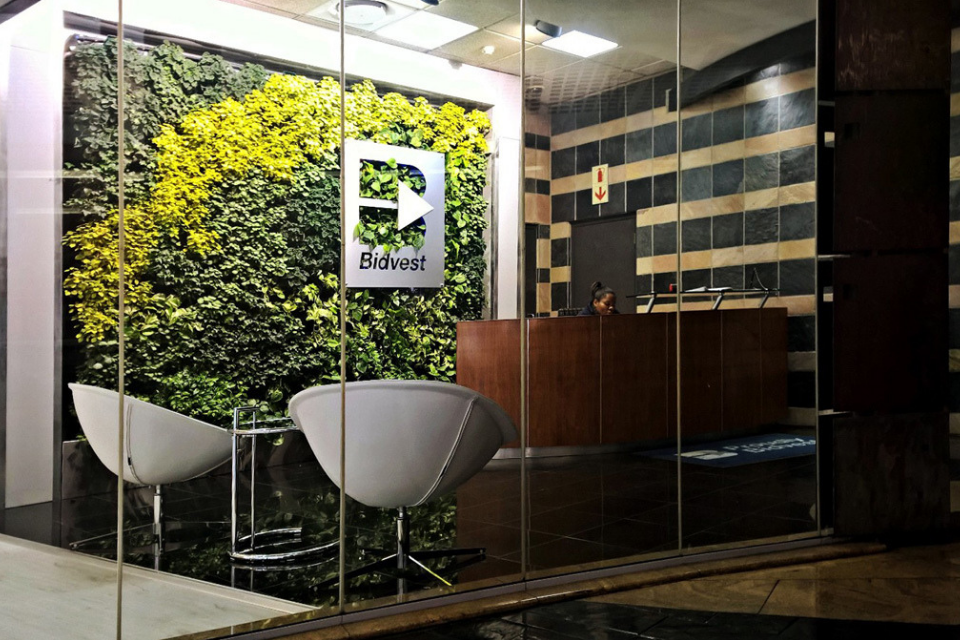
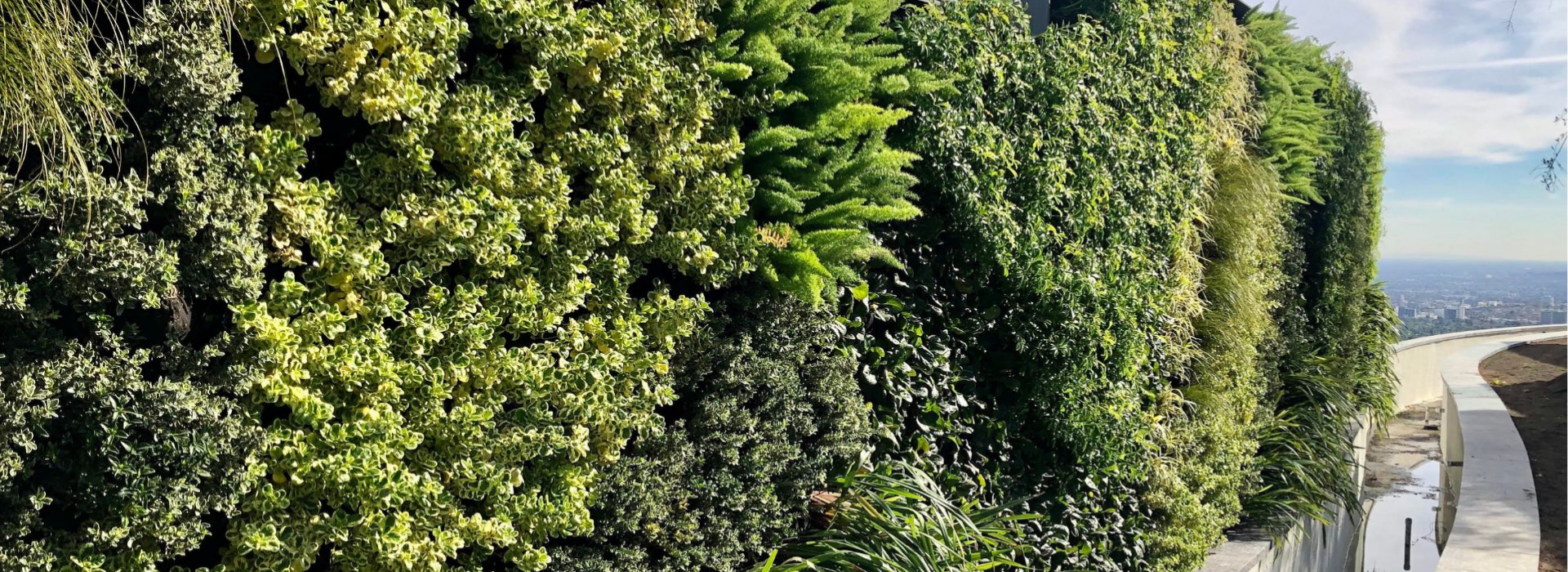
A living wall is a custom wall of real, growing plants, built plant by plant in a modular system and scaled to any size. Because GrowUp builds with full size nursery plants rather than specialty grown media, the wall reads full and finished from day one, with no growing in period. Plants can often be sourced locally, which lowers both cost and environmental impact.
It is alive, which is the whole point and also the commitment. It relies on irrigation, appropriate light, and ongoing care, and it keeps changing after handover. Leaves unfurl, plants knit together, and the wall deepens week by week. Individual plants can be swapped one at a time to refresh the look or reshape the space.
Spec a living wall when the brief calls for genuine, dynamic greenery, indoors or out, and there is a maintenance plan behind it.
.jpeg?width=1000&height=380&name=Blog%20Graphics%20(1).jpeg)
→ Explore Custom Living Walls.
What is a Preserved Moss Wall?
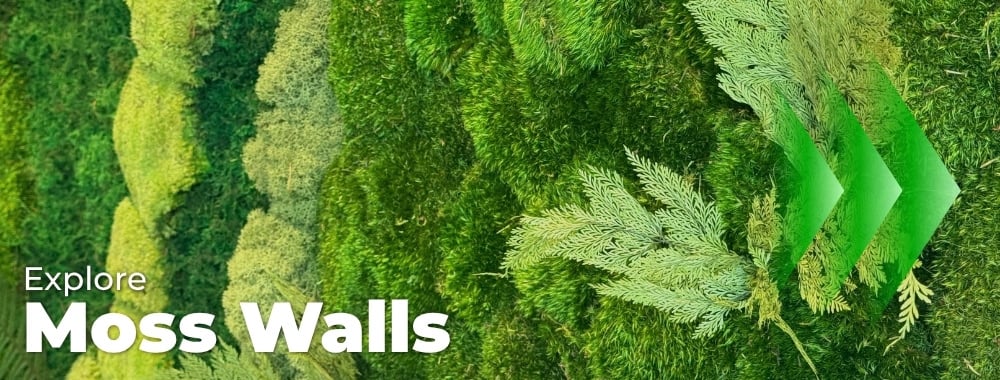
A preserved moss wall is a feature made from 100% real moss that has been sustainably harvested and preserved at its peak, then hand-fabricated into a custom composition. It looks and feels natural because it is natural, but it is no longer alive. It needs no water, no soil, no light, and no trimming. Watering it will actually damage it.
Moss softened the first hard landscapes on earth, and a moss wall does the same job indoors, bringing organic texture and quiet to concrete, steel, and glass. One constraint is absolute: moss walls are indoor only. Direct sunlight and weather shorten their life, so outdoor and high UV locations belong to faux or living instead.
Spec a moss wall when maintenance is impractical or unwanted, the location is interior and out of direct sun, and you want natural texture rather than growth.
→ Explore Custom Moss Walls.
What is a Faux Wall?
A faux wall is engineered artificial foliage, designed for realism and built to hold its look without any horticultural upkeep. It carries a 3 to 5 year factory warranty, needs nothing beyond occasional dusting, and is UV rated for outdoor use. GrowUp offers three lines: UnReal, modular silk plants in a frame across eleven standard varieties; the Evergreen Collection, panel based with fire rating available; and Dreamwalls, fully custom designed panels taken from concept through fabrication.
Faux is the right specification when the goal is the look of plants without the maintenance that living greenery requires, and when a foliage aesthetic suits the space better than the texture of moss. It is a design choice as much as a practical one. Some briefs want the layered, leafy character of planting rather than a soft green surface, and faux delivers exactly that, at any scale, indoors or outdoors, with no care schedule attached.
.jpeg?width=1000&height=380&name=Blog%20Graphics%20(3).jpeg)
→ Explore Faux Walls.
How far can you customize each one?
Design intent is where this decision gets genuinely interesting, because the three solutions hand you very different kinds of creative control.
Living walls put the freedom in the plant palette. You choose species, color, density, and leaf texture, within what will actually thrive in the wall's light and climate, so the range is real but bounded by horticulture. A living thing has to survive the spec. Where GrowUp's system goes well past most living walls is form. Because it is modular and built plant by plant, it can take almost any shape and scale, and it can be recomposed one plant at a time as the space evolves. The palette is alive and changeable, and the silhouette is yours.
Moss walls are the most creatively open of the three. GrowUp dyes its own moss, so color is effectively unlimited, and size, shape, texture, and imagery such as logos, patterns, and gradients are all available. Preserved moss also adheres to almost any substrate, which takes it far beyond a flat rectangle. Sculptural forms are buildable (we have a moss bird installation with a case study coming shortly), along with moss topped tables set with replica trees, moss ceilings, and suspended moss light fixtures. When the brief wants an art piece rather than a wall, moss is usually the answer.
Faux walls scale across three tiers of control. UnReal offers eleven standard plant varieties to mix within a frame. The Evergreen Collection is panel based with fire rated options for projects where that matters. Dreamwalls is fully custom, taking a concept through pattern, fabrication, and install. So faux runs from a fast, modular specification through to a completely custom botanical composition, all with no maintenance requirement.
Cost: upfront versus lifetime
The cost conversation that matters is not sticker price. It is total cost of ownership, because value engineering cuts on lifetime numbers rather than day one ones.
Broadly, custom living and custom moss walls carry a higher upfront investment because both are designed and fabricated to spec, and living walls add irrigation infrastructure on top. Modular faux sits lower upfront and scales up as the design becomes more custom. Over time the picture shifts. A living wall carries ongoing horticultural care, so its lifetime cost climbs, predictably and plannably, but it climbs. A moss or faux wall carries almost nothing within its service life.
Neither pattern is cheaper in the abstract. A moss wall can cost more to design than a modular faux wall costs to install and still be the more economical choice over ten years in an interior where maintenance access is difficult. The way to compare properly is to put upfront and lifetime side by side for your specific project.
Budget is rarely a fixed wall either. GrowUp's designers work closely with clients to bring an ambitious vision within reach, using creative material choices and inventive use of space to protect the design intent while respecting the number. A feature can often be reshaped, rescaled, or built from a different combination of materials to land the same effect for less. That collaboration is frequently what keeps a green wall in the project rather than on the value engineering list.
Maintenance: what each wall actually needs
Upkeep is one of the first questions a client asks, and the honest answer differs by solution type. It is also a decision you make at spec time rather than one you discover at handover.
A living wall needs scheduled horticultural maintenance: watering, light management, pruning, and occasional plant replacement. That is simply the nature of a living thing, and it is entirely plannable with a maintenance package. A moss wall needs nothing within its service life. Leave it alone and it holds. A faux wall needs no more than the occasional dusting.
If low drama upkeep is the governing requirement, moss and faux answer it outright. If the brief wants living greenery, the answer is a maintenance plan specified alongside the wall.
Light, environment, and how long each one lasts
This is the axis that quietly settles the question before cost or aesthetics enter the room.
Preserved moss is indoor and non UV only, so it is the first thing to establish, because it removes moss from any exterior or sun drenched brief. Living walls work indoors or outdoors with the right plant palette and light levels. Faux is UV rated and performs indoors or outdoors, including in dark interiors where living material would struggle.
Product lifetimes vary too. Preserved moss typically runs 8 to 10 years before any fading begins, and often looks excellent well past that, needing a touch up rather than a replacement. Faux holds its appearance for years when installed in suitable conditions. A living wall has no fixed lifespan at all, because it renews itself with ongoing care.
The specifier's real concern underneath all of this is whether the wall will look like the render once installed, and stay that way. That is answered by matching solution to environment at spec time. Get the environmental fit right and the wall performs. Get it wrong and no amount of design intent survives contact with the site.
Acoustics, wellbeing, and the outcome the client is buying
A green wall is rarely specified for its own sake. It is specified for what it does to the people in the room, and that is the argument the designer makes up to the owner who signs the check.
The evidence is strongest for living greenery. Peer reviewed field research has linked adding plants to a workspace with a 15% lift in productivity, and living walls contribute to LEED and WELL through passive air quality, acoustic softening, and thermal moderation. Preserved moss delivers the visual side of that biophilic effect, since natural color, texture, and organic complexity carry the same attention restoring qualities documented across the biophilic design literature, and moss is naturally sound softening as a material. Faux delivers the visual presence of greenery in settings where planting is not practical.
For specification purposes, match the outcome the client is buying to the solution that genuinely delivers it, and keep the claims honest to the material.
How to specify each one
The gap between a great concept and a great install is documentation: the details, materials, performance expectations, and alternates that protect design intent through pricing and substitution.
For both living and moss walls, GrowUp provides the full specifier toolkit, including CSI 3 part specifications, CAD and Revit files, and architect's design guides you can pull straight into a submittal set. Faux walls come with product specifications and warranty documentation per line. Whichever direction the design goes, the aim is the same: make the wall straightforward to spec, straightforward to price, and hard to value engineer out.
The decision, in one flow
Stripped back to the load bearing questions:
- Do you want real, growing greenery, and is there a care plan? Living wall, indoors or outdoors.
- Do you want natural texture with zero upkeep, in an interior out of direct sun? Moss wall.
- Do you want a plant aesthetic with no maintenance, indoors or out? Faux wall, from modular through to fully custom.
- Is the location exterior or high UV? Faux or living, since moss is ruled out.
- Is the brief sculptural or unconventional rather than a flat wall? Moss, which can be formed around almost anything.
The goal was never the best wall. It is the right one for the space. For office projects, our page on greenery for corporate offices matches each solution to the spaces it suits best. Because GrowUp designs and delivers all three solutions, the conversation stays about the project rather than about steering you toward a product.
Frequently asked questions
What is the difference between a moss wall and a living wall? A living wall is made of real, growing plants that need water, light, and ongoing care. A moss wall is made of real moss that has been preserved, so it is no longer alive and needs no water, light, or maintenance.
Do moss walls need any watering or maintenance? No. A preserved moss wall requires no water, light, or trimming, and watering it will damage it.
How long does a preserved moss wall last? Typically 8 to 10 years before any fading or discoloration begins. Many moss walls look excellent well beyond that, and often need only a touch up or localized repair rather than replacement.
Can a moss wall go outside? No. Moss walls are indoor only, because direct sunlight and weather shorten their lifespan. For exterior or high UV locations, a faux or living wall is the right choice.
Is the warranty the same as the expected lifetime? No. A warranty is a conservative guaranteed minimum, while expected lifetime is what the product delivers in the environment it was designed for. Faux walls carry a 3 to 5 year warranty and routinely perform well beyond it.
Which green wall offers the most design flexibility? Moss offers the widest creative range, including custom dyed color, sculptural forms, ceilings, and light fixtures. Living walls offer plant palette freedom plus considerable shape and scale flexibility. Faux ranges from modular systems through to fully custom panels.
Which green wall needs the least maintenance? Moss and faux both require essentially no upkeep. A living wall needs scheduled horticultural care, which can be handled through a maintenance package.
Are faux walls suitable for outdoor use? Yes. GrowUp's faux walls are UV rated for outdoor use and carry a 3 to 5 year factory warranty.
Which green wall is best for healthcare or senior living interiors? Preserved moss is a frequent choice where maintenance access is limited and a calm, low drama interior feature is the goal. Living walls also suit healthcare settings with the right maintenance plan.
.jpeg)
Ready to spec the right wall for your space?
Download the Green Wall Solution Type Comparison, a one page reference you can drop straight into a spec set.
Working through a specific project? Book a design consultation and we will help you weigh the options for your space, light, and budget.
Greenwall Solution Type Comparison Book a Design Consultation