Artificial office plants look intentional when they're treated as a designed element rather than a purchase. That means composing each planter for height, texture and color, sizing the planting to the planter, and placing it by zone. Done well, faux plantscaping gives an office consistent, finished greenery with no water, light or pruning required.
When office greenery falls flat, the plants are seldom to blame. A single plant dropped into a long planter, a cluster of unrelated species, a bare bed showing plastic pots: these details make greenery read as an afterthought.
This guide is for designers who want faux greenery to hold up to the same scrutiny as the rest of the scheme. We cover when artificial is the right call, how live and faux plantscaping compare, what makes an arrangement look curated, how to match planting to a design language, where to place it, and how to specify it.
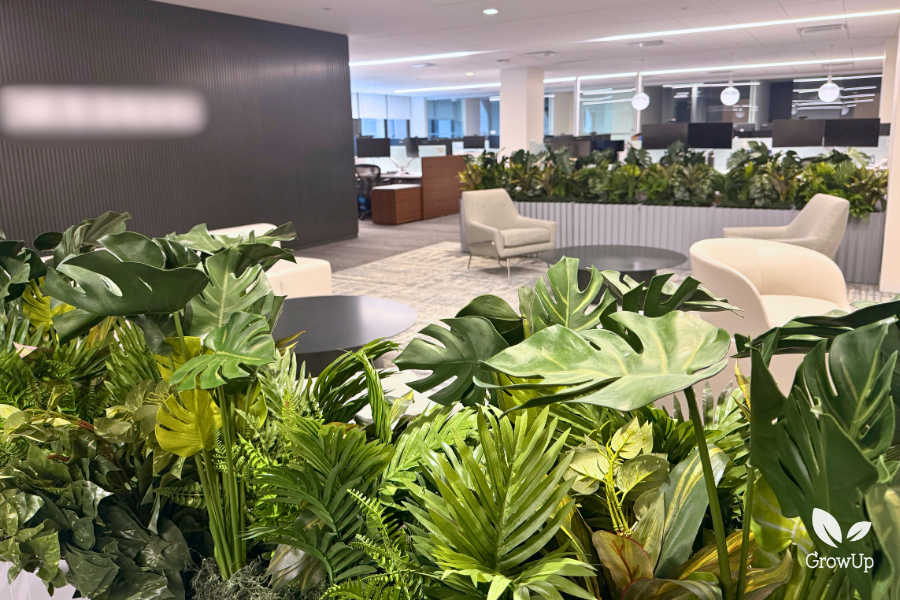
When artificial plants are the right call in interior plant design
Choosing between live and faux plants comes down to the conditions of the space and what the client can sustain after handover.
Artificial plants are the natural fit when:
- Light is low or inconsistent. Interior cores, windowless meeting rooms and deep floor plates rarely give live plants what they need.
- There's no ongoing maintenance plan. If the client won't carry a plant care contract, or planters sit somewhere hard to reach, faux greenery removes the dependency.
- The planting needs to look the same every day. Brand environments and hospitality-grade reception areas often call for greenery that stays exactly as designed.
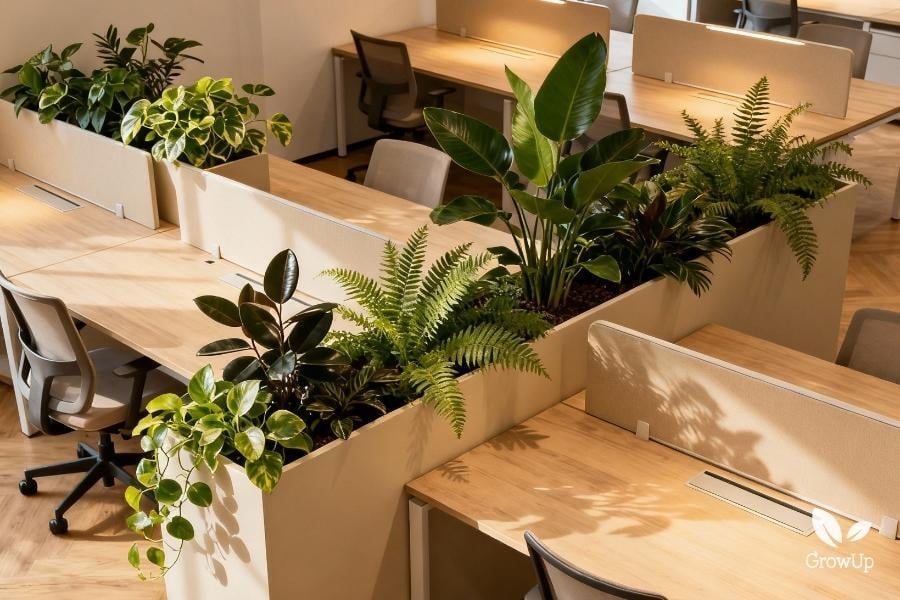
- The planter is part of the furniture. Workstation spines, banquettes and benching put planting at desk height, where consistency matters and care access is awkward.
Where a space has good natural light and a client committed to care, living plants bring something faux can't: real, growing greenery. For feature-scale living greenery, explore our custom living walls.
Live vs faux interior plantscaping for offices: a quick comparison
"Interior plantscaping" usually refers to live plants installed and maintained by a service provider. Faux plantscaping applies the same design discipline using artificial plants. Here's how the two compare for an office interior.
| Live plantscaping | Faux plantscaping | |
| Light | Needs adequate natural or grow light | No light required |
| Water and care | Regular watering, pruning and care | No water or pruning; occasional dusting |
| Ongoing service | Usually a maintenance contract | None required |
| Appearance over time | Grows and changes over time | Stays as designed |
| Best for | Well-lit spaces with a care plan | Low-light zones, built-in planters, low-maintenance briefs |
Many offices use both: live planting where light and care allow, faux where they don't. Whichever you choose, the greenery should look designed for the space.
Curated vs off-the-shelf: what makes faux plantscaping look intentional
What separates a faux arrangement that elevates a space from one that cheapens it is mostly composition. Five details make the difference.
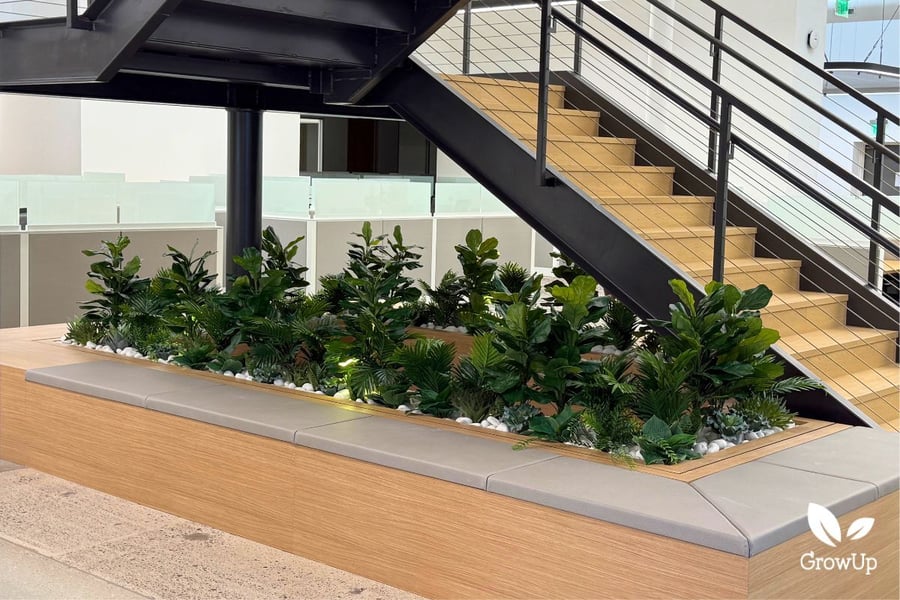
Height and layering. A considered planter works in tiers: an upright element for structure, mid-height foliage for body, and something low or trailing to soften the edge. Read the height against eye level, the furniture and sightlines across the room.
Texture contrast. Broad leaves next to fine grasses, sculptural succulents next to soft fern. Contrast is what gives a planter depth from a distance and interest up close.
Color discipline. Greens vary from blue-grey to warm olive. Choose a palette that relates to the materials around it rather than competing with them. Use flowering accents deliberately and sparingly.
The finish. Exposed nursery pots give a planter away immediately. A dressing layer of moss or stone fills the bed and makes the planting read as one composition.
Rhythm. Along a long run, repeating one arrangement creates calm and order. Alternating two creates movement. Random mixing rarely looks deliberate.
This is the thinking behind our Curated Replica Planter Arrangements: eleven professionally composed faux planter arrangements, plus custom designs, each supplied ready to place with its dressing included.
A faux plant style guide: matching arrangements to the design language
Planting should speak the same language as the interior. Here's how to approach five common design directions, with the arrangements from our collection that suit each one.
Modern minimalist
Let one strong form do the work. Choose upright, architectural plants with clean lines, repeated in a disciplined rhythm. Avoid busy mixed groupings that break the calm. Suits: Urban Greenery (clean, sleek, modern) and the single-plant Sansevieria Snake Grass, both finished with white pebbles.
Japandi and warm minimalism
Aim for quiet, natural and slightly asymmetric. Delicate branches and soft blooms suit pale timber and textured plaster. Avoid heavy tropical foliage, which overwhelms the restraint. Suits: Minimalist Zen, with cherry blossom, bamboo branch and orchid leaf over white pebbles, Vanilla Grass for soft vertical movement, and Blue Star Fern.
Hospitality-grade luxury
Arrival points want generosity. Go fuller, taller and layered, with lush foliage that reads from across a lobby. Avoid undersized planting that looks lost in a large volume. Suits: Bohemian Botanicals (leafy tropicals for a lush, full look), California Coastal (textured greens with fiddle leaf and areca palm) and the single-plant Monstera.
Biophilic and maximalist
Let the planting feel abundant and layered, like a garden brought inside. Mixed species, trailing elements and a moss-dressed bed create the effect of a continuous green line through the space. Avoid sparse spacing. Suits: Rainforest (evocative of the forest floor) and English Cottage (a romantic, garden-inspired mix), both finished with Spanish moss.
Industrial and adaptive reuse
Raw concrete, steel and brick reward bold, sculptural plants with strong silhouettes. Avoid fussy florals that feel out of place against hard materials. Suits: Succulent Sanctuary (agave, cactus and yucca over white pebbles) and Sansevieria Snake Grass.
Across the collection, arrangements range from about 13 to 26 inches above the planter, so you can match planting height to the setting, from a desk-height spine to a reception planter.
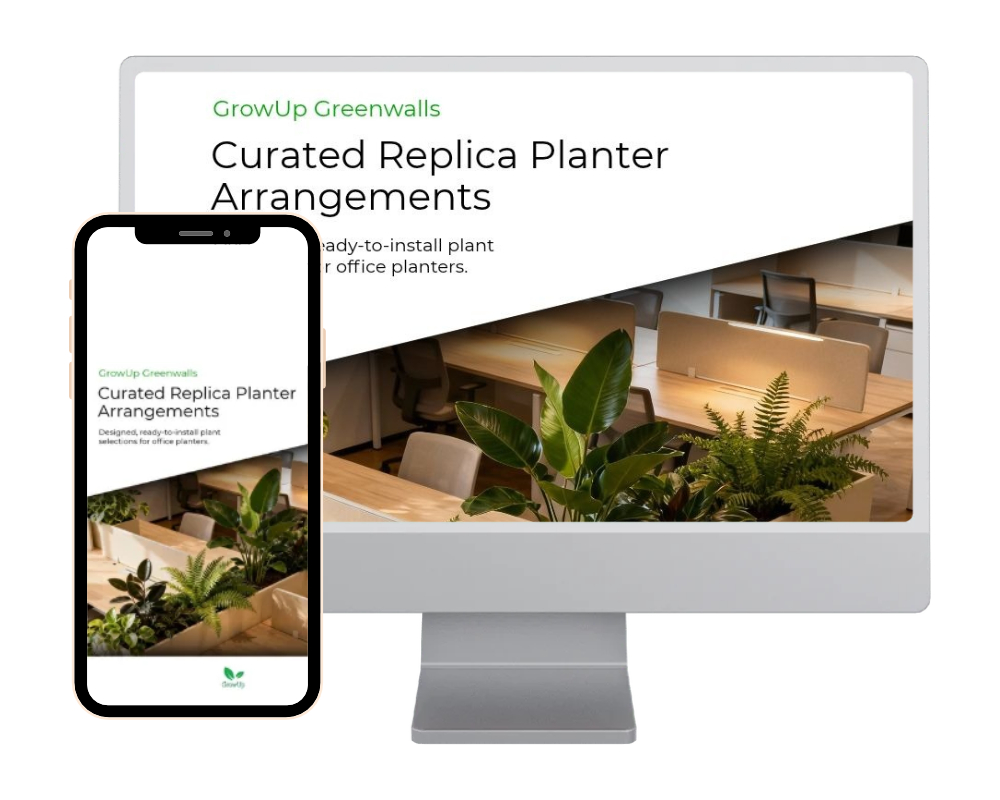
Download the Replica Planter Style Guide
GrowUp offers 11 Curated Arrangements covering a variety of styles, with options for adjustments or full customzation.
Where to place artificial plants in an office: a zone-by-zone guide
Reception and arrival
The first impression of the workplace. Scale up: taller, fuller arrangements that hold their own against the reception desk and feature wall. This is the place for your most generous planting.
Planters built into office furniture
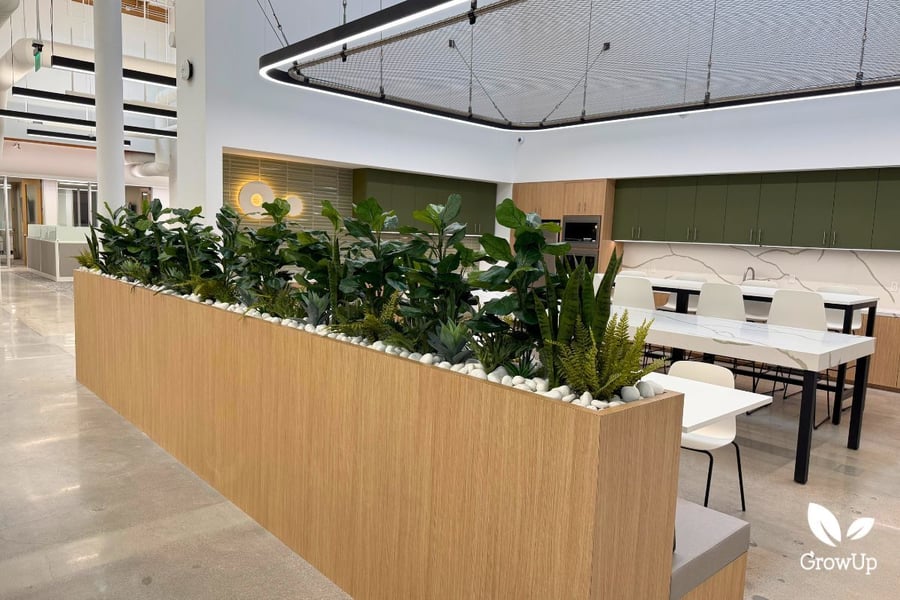
Workstation spines, banquette backs and benching planters put greenery at seated eye level, often in long, narrow beds. Choose lower arrangements that won't block sightlines, and repeat one design along the run for a clean, consistent line. Because care access is awkward between desks, faux is often the practical choice here.
Breakout and café areas
These spaces can take more personality. Mix arrangements, introduce texture and color, and let the planting shift the mood from focused to relaxed.
Meeting rooms
Often windowless and lit only when in use, which makes them difficult for live plants. A single well-composed planter or a low arrangement along a credenza adds warmth without clutter.
Corridors and wayfinding
Place the same arrangement at regular intervals to create rhythm along a corridor, and use it to mark entrances, junctions and destinations.
Terraces and outdoor planters
Arrangements can be used in outdoor planters too, carrying the interior planting out onto balconies, roof terraces and entrance courtyards. UV-rated options are available for outdoor installations. Repeating an arrangement used inside creates a continuous green line from interior to exterior.
Specifying artificial plants: a designer's checklist
Getting faux planting right on site starts in the documents.
- Confirm as-built planter dimensions. Measure the finished planter, especially for built-in and custom millwork, before ordering.
- Size the planting to the planter. As a quick guide, a planter 6–8 inches wide takes roughly one arrangement per 3 linear feet. A planter 10–12 inches wide takes about two per 3 linear feet for a fuller look. Fuller selections change the count, so confirm the final number with GrowUp. Our design guide includes the full sizing table.
- Schedule each planter. Note the arrangement selection, quantity and location.
- Ask the right questions of any supplier. Fire performance, warranty, materials and lead time vary by product and project. Confirm them in writing before you finalize the specification.
- Set care expectations. No water, light or pruning is required. Occasional dusting keeps the planting looking its best.
When to scale up: moss walls and faux walls
Sometimes planters aren't enough. When the brief calls for a feature wall rather than a planted edge, two options extend the same low-maintenance approach vertically.
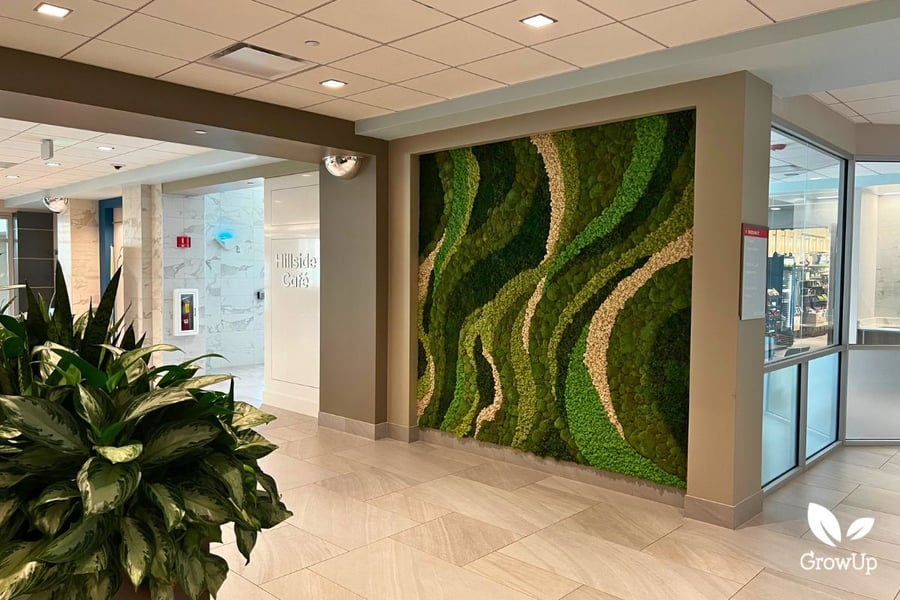
Preserved moss walls bring rich, natural texture to interior feature walls with no water, soil or light. Each wall is a custom commission that can incorporate logos, signage and artwork, and is designed for indoor use only. Explore our custom preserved moss walls.
Faux walls bring faux greenery to a larger, vertical scale. UnReal is built plant by plant from individually potted silk replicas for maximum realism. Evergreen and DreamWall are panel-based: Evergreen creates a clean, uniform field, while DreamWall allows a more intricate custom pattern. Explore our faux walls.
Not sure which system suits the space? Our guide to moss walls vs living walls vs faux walls compares them side by side.
Plants as a design decision
Artificial office plants work when they're composed, sized and placed with the same care as every other element in the scheme. Treat planting as part of the design rather than a finishing purchase, and faux greenery will hold up to the same scrutiny as the rest of the interior.
We help design teams specify faux plantscaping with confidence, from a single reception planter to a full office fit-out. Download the Curated Replica Planter Arrangements design guide or talk to our team about your next project.
Frequently asked questions
What are the best artificial plants for an office? The best artificial office plants are the ones composed for the space. Look for realistic plants arranged for height, texture and color, sized to the planter and finished with a dressing that hides the pots. Upright forms like snake plant suit modern interiors, while fuller tropical arrangements suit reception and hospitality areas.
How do interior designers make artificial plants look real? Designers make faux plants look natural through composition. They layer heights, contrast textures, keep the color palette consistent with the interior, and fill the planter bed with moss or stone so no pots show. Repeating one arrangement along a long planter also reads as more deliberate than mixing at random.
Do fake plants look cheap in an office? They can when they're uncomposed: a lone plant in a large planter, mismatched species or exposed plastic pots. Professionally curated faux arrangements avoid this by designing the full planter, including height, texture, color and finish, so the greenery reads as part of the interior.
How many artificial plant arrangements do I need for a planter? It depends on the planter's length and width. As a guide for GrowUp's arrangements, a planter 6–8 inches wide takes roughly one arrangement per 3 linear feet, and a 10–12 inch wide planter takes about two per 3 linear feet. Confirm the final count with GrowUp before ordering.
Can artificial plants be used outdoors? Yes. GrowUp's curated faux planter arrangements can be used in outdoor planters such as terraces and balconies, and UV-rated options are available for outdoor installations.
How do you clean artificial office plants? Artificial plants need no water, light or pruning. Occasional dusting or light cleaning is enough to keep them looking their best.
How much do artificial plant arrangements cost, and what's the lead time? Pricing and lead time depend on the arrangements, quantities and project. GrowUp quotes each project individually. Contact our team for a quote and schedule.
What is interior plantscaping, and can it use artificial plants? Interior plantscaping is the design and installation of plants in interior spaces. It traditionally refers to live plants with ongoing maintenance, but the same design principles apply to faux planting. Many offices combine both, using live plants in well-lit areas and faux arrangements where light or maintenance is limited.
When should I choose a moss wall or faux wall instead of planters? Choose a wall when the design calls for a vertical feature rather than a planted edge, such as a reception backdrop or branded wall. Preserved moss walls suit interior feature walls, while faux walls offer larger-scale vertical greenery. Our moss vs living vs faux wall guide compares the options.